
PA Assesses the Grid and Plans to Redevelop Shuttered Power Plant Sites

What is the PATER Study?
Earlier this year, Pennsylvania received a $2.5 million grant from the Department of Energy to assess the state’s electricity grid and to identify shuttered fossil fuel power plant sites for redevelopment. The study was called “PATER,” for Pennsylvania Accelerated Transmission and Energy Redevelopment Study. It will be performed in two phases and aims to strengthen the transmission grid, identify new power generation opportunities, and invest in former energy communities.
This assessment of the grid and investment in forgotten energy communities is long overdue. It comes at a time when Pennsylvanians’ economic and environmental interests seem at odds with the state’s economic development entities. While residents struggle to afford their electricity bills, groups like Team PA are focused on attracting energy-hungry industries such as data centers to the state—but who is giving the input matters, because not all of these groups and industries keep the interests of everyday people in mind.
The decisions made because of the PATER Study will have sweeping impacts on the state’s power grid, energy mix, and statewide economy. Those decisions will also directly impact the environmental and economic health of the former energy communities chosen to host redevelopment projects. Needless to say, the stakes are high.
View this post on Instagram
The Study’s Initial Site Selection
Starting with a list of 76 former fossil fuel power plant sites that burned coal, oil, or gas to generate electricity, Part A of the study used about 60 characteristics to narrow the list to 21 candidate sites. These sites are being assessed for several types of redevelopment projects that fall into three categories—energy generation, energy-intensive user (like a data center or manufacturing facility), or generation co-located with an energy-intensive user. The study will now recommend these sites for consideration in the next phase.
Assessment of Transmission Infrastructure
The grid assessment component will evaluate existing infrastructure assets, current and potential capacity, bottlenecks, and upgrade opportunities. The study will map lines, substations, and connections to assess current conditions and will determine where adding power could reach a limit. Reliability is a stated priority, and the study will evaluate outages and operating conditions that stress the grid. The study will identify upgrade opportunities by assessing local technology capabilities and equipment options.
Modernizing Pennsylvania’s grid infrastructure is vital to improving efficiency, reliability, and resilience. The PATER Study explores how best to deploy technology that enables dynamic line ratings and power flow controls to optimize the use of existing lines, alongside upgrading equipment to address infrastructure limits. Optimizing existing infrastructure is a cost-effective way to ensure electricity flows where and when it is needed. Where existing infrastructure does not meet current or future needs, the study will explore the potential to build new transmission infrastructure.
Building Electricity Generation and Redeveloping Shuttered Power Plant Sites
The PATER Study is assessing former fossil fuel power plant sites to create a short list for redevelopment options, including building new energy generation, developing an energy-intensive industry, or co-locating new energy generation with industry. The study considers gas-fired power plants (both simple-cycle and combined cycle), gas fuel cells, small modular nuclear reactors (SMRs), onshore wind, solar, and battery storage systems as options for new generation. The energy-intensive users, or large load customers, being considered include semiconductor manufacturing, electric vehicle battery factories, pharmaceutical and biotechnology facilities, automotive manufacturing plants, and food and beverage processing facilities. The study’s authors are also considering various types of data centers, including enterprise, colocation, hyperscale, and AI-optimized facilities.
According to the authors, the final short-list sites will offer opportunities to quickly deploy new electricity generation, rapidly deploy energy for large load customers, invest in transmission infrastructure to maximize economic benefits, and “create durable, long-term economic growth” statewide. While the study expresses interest in lowering energy costs for Pennsylvanians by modernizing transmission infrastructure and increasing power generation, it’s necessary to highlight that the authors also aim to provide a pathway for energy-intensive industries to expand rapidly.

Red Flags – Will the PATER Study Result in a Data Center and Fracked Gas Buildout?
The study’s concentration on co-locating generation with data centers, combined with the authors’ consultation with groups focused on marketing Marcellus Shale gas, raises concerns. Over the course of this study, the PUC is collaborating with the Department of Community and Economic Development (DCED), Team PA, and PA Energy Horizons. These three entities have a history of promoting fossil fuel projects. The DCED’s Energy Program aims to attract energy-intensive industry to the Commonwealth, and the Department has worked with data center and tech companies, like Amazon, to expand development across the state. Team PA, a nonprofit economic development organization that frequently collaborates with the DCED, recently released its Energy, Data Center, and Artificial Intelligence Roadmap, which describes how Pennsylvania can attract data center developers with fracked gas to fuel their facilities. PA Energy Horizons also heavily promotes Marcellus Shale gas and the development of two unproven technologies—CCUS (Carbon Capture, Utilization, and Storage) and hydrogen—while claiming to work towards decarbonizing the statewide economy.
Consulting with these three fossil-friendly groups is not the only red flag in the initial phase of this project. While promoting the economic benefits of building new gas plants and highlighting the ease of connecting to existing gas infrastructure, the study downplays the advantages of solar panels sited with battery storage. Solar and battery storage are cheap and fast to deploy— with projects taking only 12 months to complete. In comparison, a gas-fired power plant can take an average of 22 months to build and connect. This affordability suppresses prices across the market to help lower costs for ratepayers quickly. A less-discussed advantage of solar and storage is that they have little to no operational or maintenance costs. Frustratingly, “land intensity” of solar—meaning, the amount of land needed to generate electricity—seems to be a concern for the authors. If the authors are willing to consider sites large enough to accommodate a gas-fired power plant co-located with a hyperscale data center that would take years to complete, it should give equal or more weight to a solar farm co-located with battery storage that can be completed in a year—assuming the goal of this project is really to lower energy costs and increase grid reliability.
 Planning for Large Load Users is a Distraction
I’ll say it again—renewables and battery storage can be built and deployed in 12 months. The average timeline for a gas-fired power plant is nearly double that—22 months. Renewables and battery storage projects typically do not include additional operations or maintenance costs over the course of their lifetime, further reducing their total cost.
If the goal of the PATER Study is to increase the amount of power available on the grid, improve reliability of service, and reduce costs for ratepayers, renewables co-located with battery storage—alongside transmission upgrades—make the most sense.
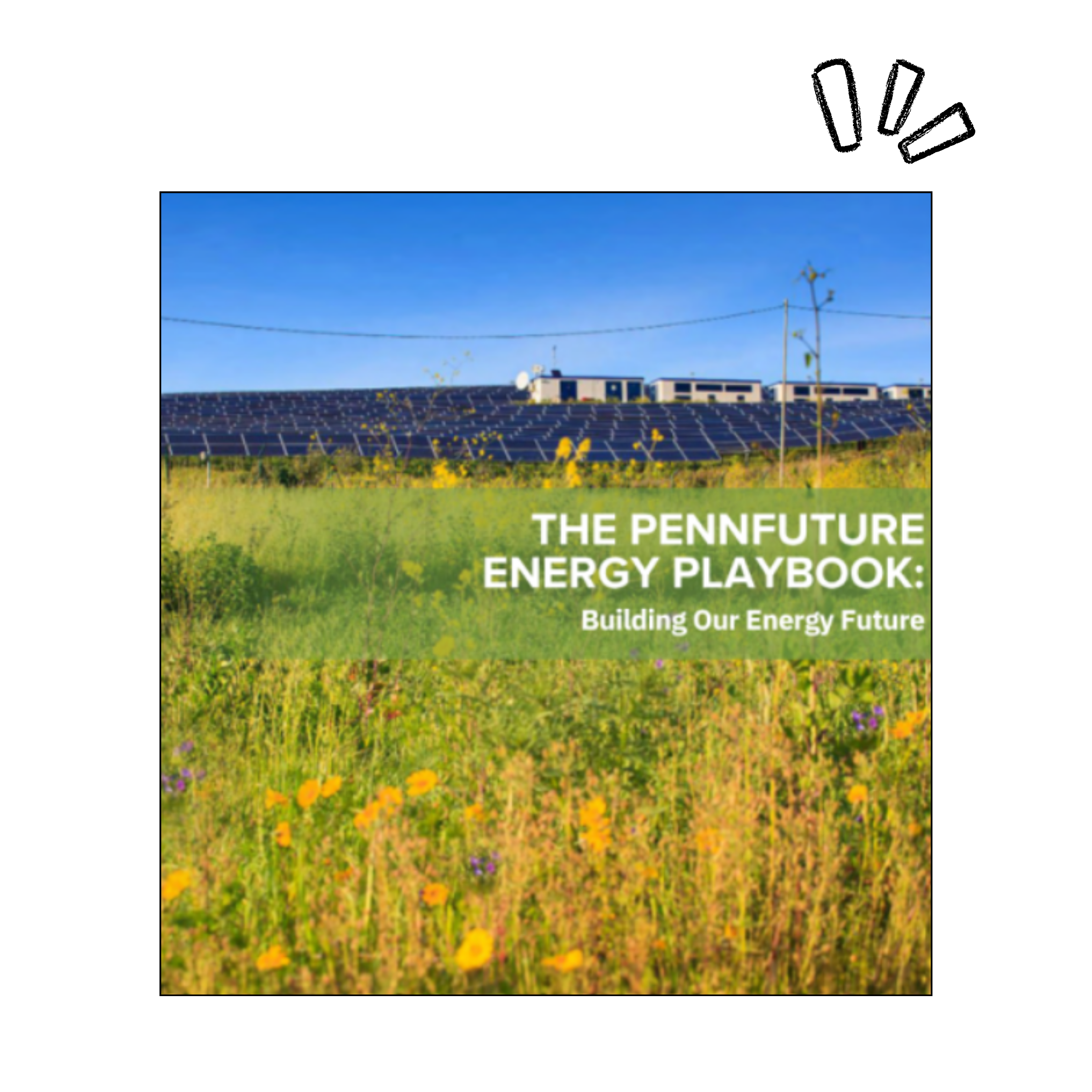
As we noted in our Energy Playbook: Building Our Energy Future, building massive gas-fired power plants to address peak power demand does not make economic or environmental sense. Instead, we must optimize existing transmission infrastructure, bring the fastest, cheapest-to-deploy sources online (solar), and add battery storage to offer on-demand energy and flexibility.
The added goal of expanding data center development—using possible manufacturing opportunities as a cover—is a distraction and an unnecessary side quest. Pennsylvanians need lower electricity bills (according to PATER, we’ve seen our energy prices increase by about 46% between 2018 and 2025), a reliable grid, and reduced pollution and greenhouse gas emissions. Our state already relies too heavily on fracked gas, which makes up about 59% of our energy generation mix. Frankly, as the nation’s fourth largest emitter, the state would be remiss not to use this valuable information to build a greener grid.
Part B will use the data presented and public comments received in Part A to narrow the existing list of 21 sites down to five to seven. Another public comment period will occur before the study concludes in December 2026.
View this post on Instagram
Sending a Message and Watchdogging the Process
Amid the overlapping energy and affordability crises, the PATER Study’s recommendations must lead to redevelopment opportunities that benefit local host communities and ratepayers across the state. PennFuture is concerned that this valuable opportunity to jumpstart the modernization and decarbonization of Pennsylvania’s grid will be cast aside in favor of building expensive, polluting fossil fuel generation to serve the capital-intensive, low-employment data center buildout currently sweeping the state.
Economic stability and prosperity do not result from a massive influx of capital leveraged to build giant, controversial projects. Instead, stability and prosperity come from a diverse and sustainable economy that circulates money locally and reduces energy costs and pollution for Pennsylvanians. This study must result in projects that serve the public good and align with economic and environmental interests.
You can read PennFuture’s public comments on the PATER Study in full here.
To learn more about our sustainable economic development work, you can see our full body of work and priorities here.