Data Centers
As the world changes, new land uses are emerging: Data centers are looking to move in and Pennsylvania must be prepared.
Data centers are disrupting communities across Pennsylvania. These facilities house IT equipment such as servers, data storage drives, and other types of network equipment to store and process digital data for companies or individuals. They come in all sizes, from shipping container-sized micro data centers to multi-building “hyperscale” facilities that cover hundreds or even thousands of acres. Data centers have existed for many years, but increased demand, mostly driven by the development of artificial intelligence (AI), has caused a dramatic uptick in data center development plans.
Policy Position: PennFuture released a statement on March 18, 2026, detailing our position to support a statewide moratorium on data centers. Read the full statement here. Continue reading to learn more about statewide moratoriums on development.
ABOUT DATA CENTERS
(Click to expand for more information!)
Pennsylvania has many characteristics that are desirable for data center development–comparably cheap available land, a robust power grid, abundant water (which data centers use for cooling systems), a relatively low risk of natural disasters, and proximity to population centers. In fact, Amazon Web Services, one of the world’s top data center “hyperscalers,” has already pledged to spend $20 billion on data centers in the state.
While it's true that Pennsylvania has many characteristics that are attractive for data center development, it's worth noting that the state is making a conscious effort to attract the industry. The Team PA Foundation (Team PA) is a nonprofit organization that works directly with state agencies to grow the Commonwealth's economy.
Historically, Team PA has centered the fossil fuel industry in its economic development efforts. More recently, its projects focus specifically on fueling data centers and AI with fracked gas. The organization convened members of their Cross-Sector Collaborative in 2024 to outline three potential futures for the state's energy economy. When the project was released in 2025, it was clear that each future relied on doubling down on fracked gas as the dominant energy source, even at the expense of the environment and knowing it would raise energy costs for Pennsylvanians. Team PA then released their Energy, Data Center, and Artificial Intelligence Roadmap, which lays out their statewide economic development plan–attract the data center and AI industries with the promise of "cheap" fracked gas, fast-tracked permitting, and financial incentives.
Like any large scale land use, data centers have potential benefits and drawbacks. They create temporary construction jobs when being built and a limited number of full-time jobs and can generate tax revenue.
Data centers can also cause significant environmental harm and quality of life issues if not sited and regulated properly. There are major concerns with data centers from an environmental perspective: impervious coverage, water consumption, air pollution, and power usage. With hyperscale and multi-building campuses becoming more common, the conversion of large areas of forest or other natural ground cover to building and pavement risks dramatically altering wildlife habitat, stormwater runoff, and ecosystems. Data centers often use water-based cooling systems that can consume hundreds of thousands of gallons of water per day, potentially depleting aquifers and surface waters. These facilities also use enormous amounts of electricity, putting strain on our electric grid and driving demand for more power, often generated from harmful fossil fuels like fracked gas.
AVAILABLE RESOURCES
Here's a library of short video presentations created by PennFuture staff that explain what data centers are,
their potential impacts, and how municipalities can plan and prepare for them.
.png?resize=0x160)
.png?resize=0x160)
.png?resize=0x160)
.png?resize=0x160)
.png?resize=0x160)
.png?resize=0x160)
Data Center Impact on Your Power Grid
.png?resize=0x160)
What Can Municipalities Do to Prepare for Data Centers?
.png?resize=0x160)
Municipal Curative Amendments & Data Centers
In Pennsylvania, municipalities are responsible for controlling how land is used and where various types of development can be sited. They are the first line of defense when it comes to ensuring that data center development happens responsibly. While PennFuture calls for a statewide moratorium on data center development, it also recognizes that, unless and until such a moratorium is in place, municipalities continue to bear responsibility for placing reasonable controls on data center development.
PennFuture is here to help! We understand that learning the ins and outs of new land uses and their potential impacts can be complicated and time consuming for municipal officials. That’s why we created a model zoning ordinance to give municipalities the information and tools they need to make informed decisions when planning for data centers.
This model ordinance includes suggested provisions addressing water consumption, noise, and aesthetic concerns, and was created in consultation with experts after reviewing numerous ordinances passed in Pennsylvania and northern Virginia, the data center capital of the world.
Municipalities must take seriously their responsibility to plan for this new land use and avoid being caught unaware, as many were when the distribution center boom struck Pennsylvania in recent years. With the help of our resources, PennFuture is confident that Pennsylvania municipalities are up to the task!
Now, learn how to help your township implement PennFuture’s model data center ordinance! Local governments need to have laws on the books before a data center is proposed to protect the community and set standards legally. Use our third resource, this step-by-step guide to get a data center ordinance passed in your community.
Additional resources to help protect your community from data center development:
- Explore how local governments make land use decisions and how you can participate in the process with our Public Participation Guide.
- Don’t know who your local elected officials are, like township supervisors and city councilmembers? Use this site, input your County and Municipality, and click Run Report!
- While the state legislature may have the power to “hit pause” on data centers, Pennsylvania law prevents municipalities from outright banning data centers or placing a moratorium on them. This is not an actionable option. Check out this video to learn more.
- And if you want to learn more about how one region is preparing for data centers headed their way, check out our blog on Pocono Municipalities.
The rapid pace and relatively new nature of the data center industry have prevented many municipalities from putting thoughtful, protective ordinances in place—leaving communities, our environment, and infrastructure at risk. Therefore, PennFuture calls for a statewide data center moratorium until strong state regulations that reflect our Data Center Principles are in place. Read the full statement here.
Our data center policy tracker analyzes each data center bill we’ve engaged with, evaluating whether it aligns with our four Data Center Principles.
PennFuture’s Data Center Principles include state policies that:
- Provide meaningful protection of our public natural resources and our constitutional right to clean air and pure water as provided under Article I, Section 27 of the Pennsylvania state Constitution.
- Ensure that existing utility customers are not subsidizing costs associated with data center buildout.
- Require facilities to demonstrate that they have secured the necessary power to support their operations before these facilities are connected to the grid.
- Promote the development of new, clean energy sources to increase grid reliability and lower electricity costs for Pennsylvanians.
Want to do an even deeper dive into our data center resources? Check out some of our past hour-long webinars.
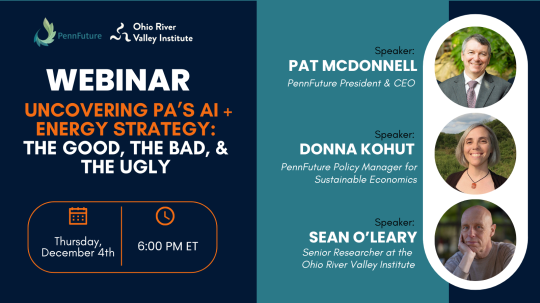
December 4, 2025: Uncovering PA’s AI & Energy Strategy- Learn more about Team PA's vision to bring more fracked gas data centers to PA and what this means for us.
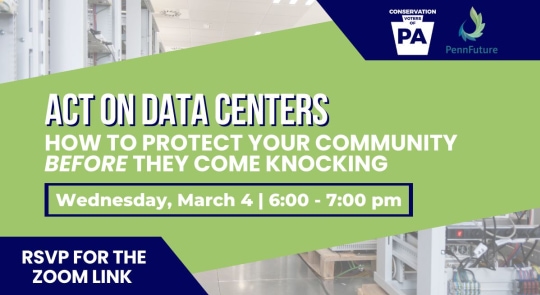
March 4, 2026: Act On Data Centers: How to protect your community before they come knocking- Learn how to engage with decision makers and prepare in advance to proactively protect your community and environment.

June 16, 2026: A Conversation About Data Centers - Sponsored by Climate Power, we discussed the energy challenges posed by data centers in Pennsylvania and policy and industry solutions that harness clean energy to meet rising energy demand. View slides here.
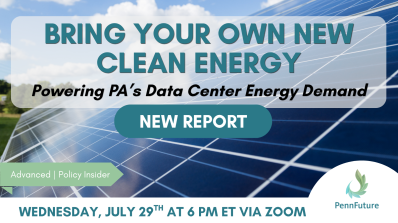
July 29, 2026: Bring Your Own New Clean Energy: Powering Pennsylvania's Data Center Energy Demand- This is an advanced policy discussion about why BYONCE – Bring Your Own New Clean Energy (like renewable energy and battery storage) is the most effective solution for meeting growing energy demand from data centers. You can view the report here.